


Oxidative stress is a powerful marker of post-operative recovery. StatOS is a bedside device that uses voltammetry to measure oxidative stress with just two drops of a blood sample.
Auckland University scientists had 10 years of research proving the value of oxidative stress markers and needed a practical way to translate this science into a fast, affordable bedside test. This solution was required to met funding, regulatory, and clinical usability requirements. InFact was invited to join Auckland University’s Bioengineering Institute (ABI), School of Biological Sciences and Department of Surgery to transform their research into a clinically viable diagnostic platform, verify its robustness, and provide a scalable design-for-manufacturing template to support clinical trials by the university and their spin out company, Paxion Scientific.
InFact subsequently developed a mobile measurement device, incorporating a disposable cassette that separates blood to plasma passively on the chip with microfluidics, eliminating the need for complex centrifugation steps. A number of sample handling features were incorporated to ensure test stability. The integrated results are able to report to a clinical data management system.
The potential application of real-time oxidative stress testing meant StatOS secured project support by the Wellcome Leap fund.
StatOS is currently being rolled out for more expansive clinical studies to verify its clinical performance, with the aim of deployment into post-operative care clinics worldwide.
A new benchmark in post operative and critical-care diagnostics.
StatOS
by Paxion Scientific

InFact likes to understand the why as much as the how of bringing science into reality.
Anthony Phillips // Professor // University of Auckland
The Project
The project team works side-by-side with the client to ensure product functionality, marketability and usability are resolved through proof of concept prototypes. These are tested and refined to ensure all aspects of the solution are understood, key risks are identified and project goals are achieved.
THINK
With deep experience across the technologies required for this product, InFact rapidly established the system architecture, defining the hardware, embedded control and user interface foundations. Development focused deliberately on the highest risk areas, with parallel engineering streams allowing critical subsystems to mature simultaneously.
The disposable cassette was developed as a microfluidic blood separation system, removing the need for a centrifuge. This reduced user steps and handling complexity, lowering clinical risk and simplifying workflow for clinicians.
Progress was driven through a staged, iterative development approach: early prototypes proved core fundamentals,subsequent iterations addressed key usability risks and later builds established confidence for funding and validation. In parallel, the thermal module was engineered to deliver significantly improved accuracy and control. A modular internal architecture ensured flexibility for future product applications.
Alongside technical development, InFact identified and engaged capable, compliant manufacturers for specialised components, supporting supply chain readiness in parallel with engineering. This approach enabled steady progress despite the combined constraints of clinical practice, FDA compliance, and the need for a cost acceptable patient test regime.

LISTEN
InFact worked closely with clinical professionals and scientists from Auckland University’ to understand the challenges of translating oxidative stress research into a bedside diagnostic system. Early engagement revealed significant unknowns in both the science and the technology, presenting major risks to the reliable measurement of anti oxidant markers.
The project required accurate, repeatable performance while meeting clinical usability, funding milestones, and regulatory expectations. For InFact, the core challenge was identifying and managing these unknowns early, locking down known parameters, and structuring a staged development approach to de risk blood to plasma separation sample processing within tight timeline constraints.
OUTCOME
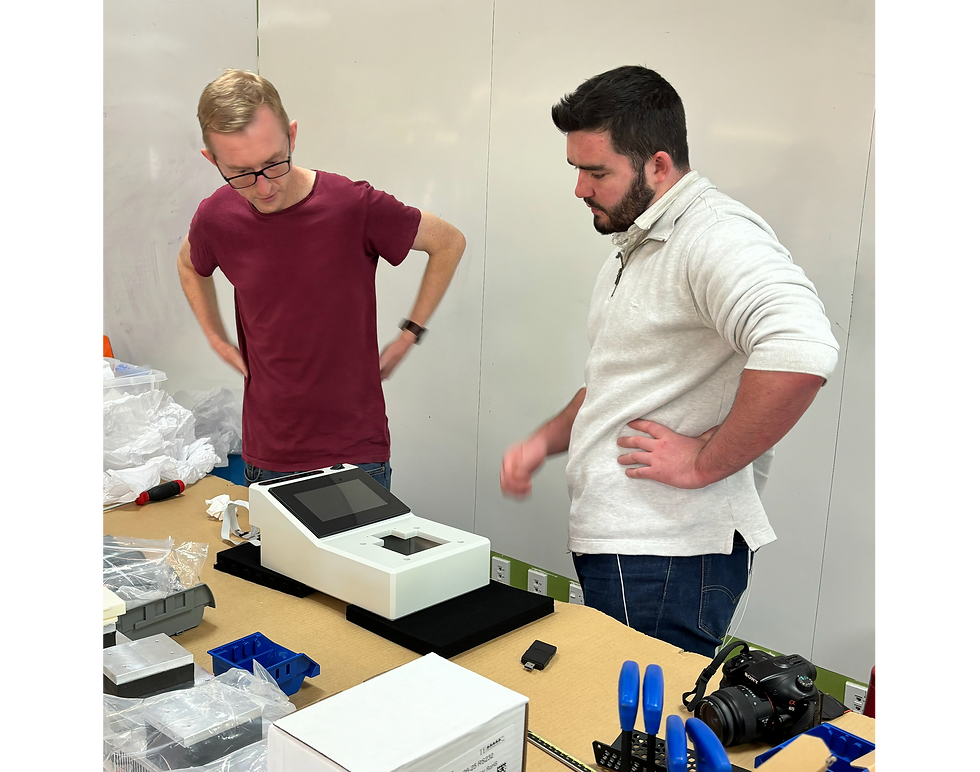
Over three years, two iterations of the product and more than 200 variants of the consumable were developed, built and evaluated. The integration of the wide array of technologies into a simple to use, low-cost platform for clinicians was achieved.
The product is now ready for expanded international clinical trials and to enter its design for manufacture and compliance programme. There is a significant demand for MedTech devices which reduce patient recovery times. StatOS is an example of how clinical research, backed by multidisciplinary engineering can improve patient outcomes at a global scale.
