


Applying consistent coatings to curved surfaces had been a persistent constraint for micro-technology teams, as most established coating methods assume flat samples. Options that could handle curvature existed, but they were slow, awkward to work with, or tied to expensive laboratory setups. That made exploratory research difficult and limited how quickly ideas could be tested. InFact was approached by the University of Canterbury to develop a solution. The aim of the project was to solve their challenge by bringing precise, repeatable motion to curved and cylindrical geometries in a form that could operate directly in the lab.
InFact collaborated directly with the University research team, providing the engineering capability to advance the programme through the efficient delivery of functional, lab-ready system. Key decisions were made around the mechanical platform and motion architecture, moving away from conventional robotic arms and toward a system that sped up spin‑coating research for a range of curved applications. InFact also handled motor control, embedded systems, software, testing, and follow‑up support, absorbing the complexity that would otherwise have fallen solely on the researchers.
The result delivered what the project called for. The machine coats curved surfaces quickly and consistently, with controlled motion and responsive operation. After delivery, it was ready to run in the lab with minimal setup. That shifted the pace of the research, letting the team produce original experimental results far sooner than if the University of Canterbury research team had attempted building the system in-house.
Multi‑axis spin‑coating system for uniform coatings on curved surfaces
CurveCoater
by University of Canterbury

InFact’s support was invaluable… It got us from zero to one in a timeframe that was unachievable otherwise
Mathieu Sellier // Professor // University of Canterbury
The Project
The project team works side-by-side with the client to ensure product functionality, marketability and usability are resolved through proof of concept prototypes. These are tested and refined to ensure all aspects of the solution are understood, key risks are identified and project goals are achieved.
THINK
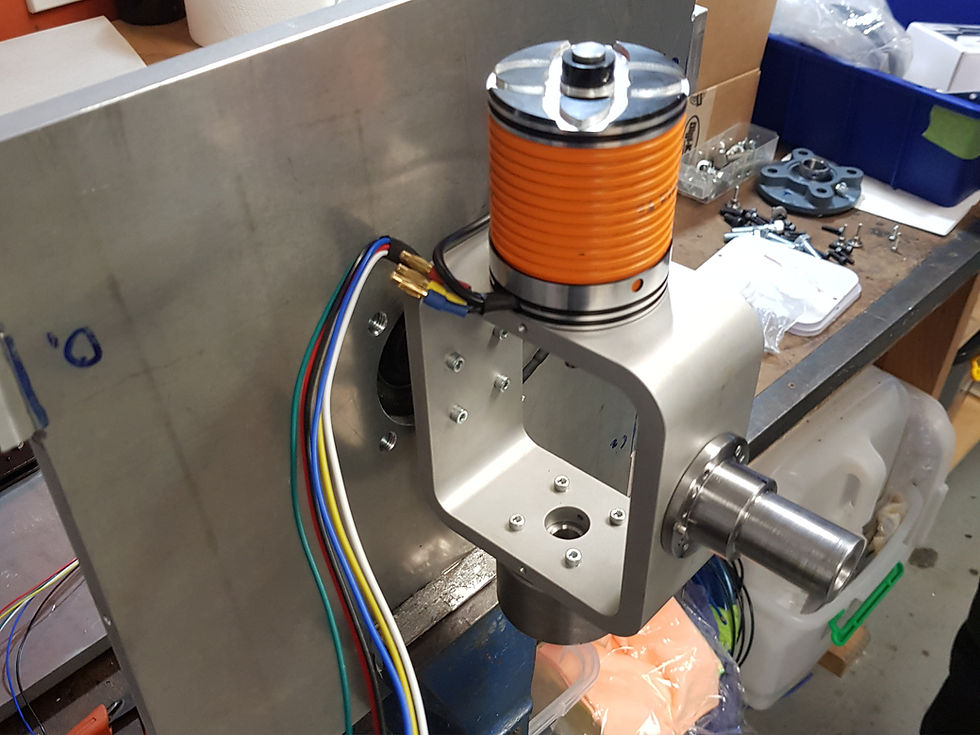
Rather than modifying existing flat spin coaters, InFact started again from first principles. The team designed a multi‑axis mechanical system where several rotations could be tightly controlled and coordinated, allowing liquid coatings to spread evenly over curved surfaces.
Custom motor control software handled high‑speed motion while keeping runs repeatable. Safety was built in from the start, with enclosed moving parts and fail‑safes suitable rated to academic lab standards. The system went through multiple prototype rounds, with researchers testing it then feeding back on what worked, what didn’t, and what needed to be simpler.
The final design reflects that back‑and‑forth. It meets demanding technical requirements while keeping everyday use simple and user-friendly, drawing on InFact’s experience in mechanical design, embedded control, software, and safety‑critical systems.
LISTEN
IInFact worked closely with researchers from the University of Canterbury, particularly those involved in mechanical engineering, microelectronics, and advanced materials research, to understand the limitations of existing laboratory equipment and the requirements of their experimental work.
Through this engagement, we learned that traditional spin coating systems, while effective for flat substrates, could not deliver consistent or repeatable coatings on curved geometries such as spheres and cylinders. This limitation prevented researchers from experimentally validating mathematical models and first principles central to their research goals.
We also learned that there was no off‑the‑shelf solution capable of meeting these needs, and that a one‑off system tailored specifically to the university’s research objectives in microelectronics and surface science was required. For InFact, this presented the challenge of designing a bespoke, industry‑grade research tool capable of precise, high‑speed, multi‑axis operation, while also meeting laboratory safety standards and remaining practical & reliable for rigorous academic use.
-ID.jpg)
OUTCOME
InFact delivered the end‑to‑end design and development of a bespoke, industry‑grade multi‑axis spin‑coating system within a one‑year timeframe. The project included mechanical design, fabrication of custom spherical substrates, creation of customised control software, and custom motor‑control code written specifically to drive the system’s multi‑axis motion.
The resulting CurveCoater provides researchers with a powerful assisted‑research tool, enabling them to accurately and consistently coat spheres, cylinders, and other complex geometries while maintaining precise control over coating parameters. By eliminating a significant technical barrier and replacing unsuitable flat‑substrate equipment, the machine has opened the door to experiments that were previously difficult or costly, directly enhancing research efficiency and precision in microelectronics and advanced materials.
Today, CurveCoater is a core asset in the University of Canterbury’s laboratory toolkit, helping researchers accelerate experimentation and achieve more reliable validation. The project also strengthened InFact’s in‑house capability in multi‑axis manipulation, embedded control software, safety‑critical system design, and full‑system fabrication.
